cektrans
Realtime tracker for TransPalu and Trans Donggala BRT — surfacing live bus positions and arrival estimates straight from the operator's Mitra Darat feed, in a fast web app that opens in any browser without install.
// Problem
The Challenge
The BRT Nusantara backend that powers TransPalu and Trans Donggala already exposes realtime data — but not to the public. Payloads are wrapped in AES-256-CBC encryption, keys live with operators, and there's no official public interface that shows bus positions to end users. Riders in Palu and Donggala had no simple way to check whether a bus was close, far, or not even running yet — they had to walk to the halte and hope.
// Solution
What We Built
Banua Coder built cektrans as an independent tracker for TransPalu and Trans Donggala. A Rust proxy (axum + socketioxide + rust_socketio) bridges the encrypted operator API: handling AES-256-CBC crypto, REST caching, and Socket.IO fan-out to browsers. On the client, a Vue 3 SPA with Leaflet renders a live map, corridor list, halte detail, arrival estimates, and a trip planner — install-free, opening in a browser on phone or desktop.
Context
TransPalu and Trans Donggala are two Bus Rapid Transit (BRT) services in
Central Sulawesi, operated locally and integrated with the BRT Nusantara
backend maintained by Mitra Darat. The operator system already tracks every
bus in realtime — but its data lives behind an internal API where payloads
are wrapped in AES-256-CBC encryption with keys only operators hold. No
official public-facing app surfaces those bus positions to riders, so
commuters had no way to check whether a bus was nearby before walking to the
halte.
cektrans was built as a bridge: pulling live data from the operator backend, handling it safely on the server, and surfacing it to the public in a fast, phone-friendly web interface.
App Showcase
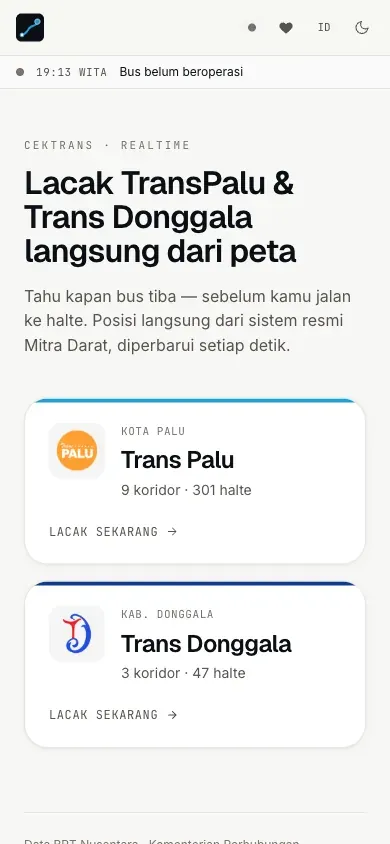
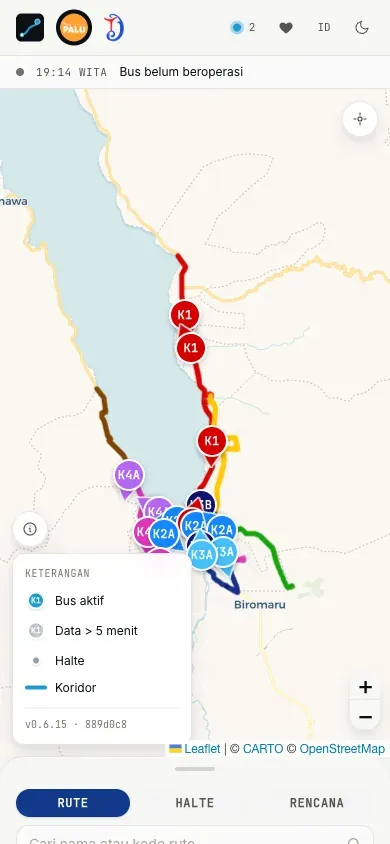
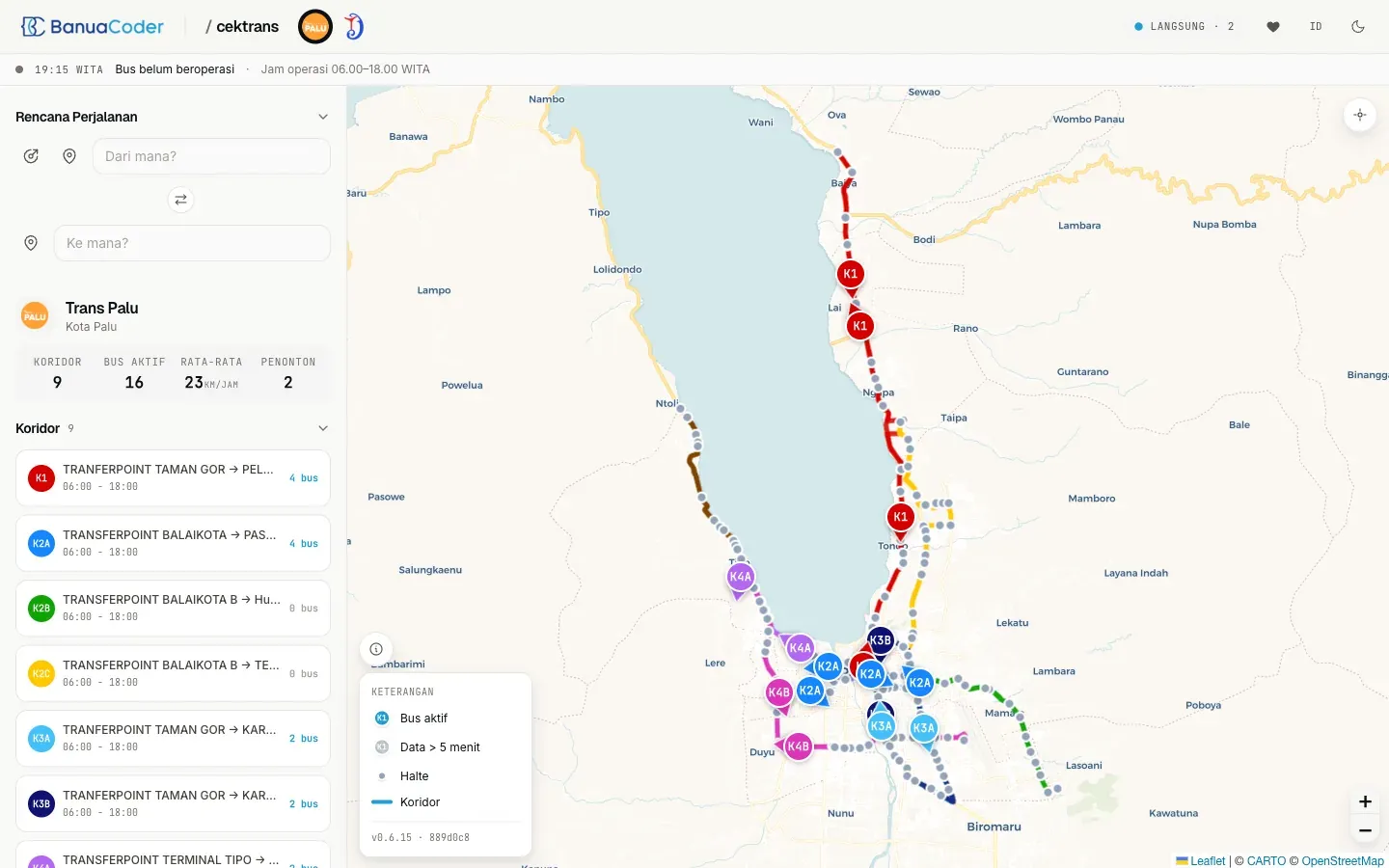
What We Built
- Rust proxy: An
axumservice that wraps the operator API. HandlesAES-256-CBCtoken and body crypto, REST response caching, and a Socket.IO bridge between upstream (rust_socketio) and clients (socketioxide). Operator keys and endpoints live in the proxy environment only — the frontend never touches them. - Vue 3 SPA: Leaflet for the map, Pinia for global state (corridors, haltes, active buses), Vue Router for navigation between cities, and Vue I18n for bilingual support. Tailwind v4 keeps the look consistent with the Banua Coder brand.
- Realtime UX: Buses move on the map the moment updates arrive over Socket.IO. Every corridor has its own colour, and each halte has a card showing incoming buses with arrival estimates.
- Trip planner: Riders can pick origin and destination haltes, and the app suggests sensible multi-corridor routes.
- Ops: Two containers (web + proxy) built via Dockerfiles, run via
docker composebehind Traefik with Let’s Encrypt TLS. Build version and SHA surface in the footer for traceability.
Engineering Notes
The hard part isn’t the UI — it’s the proxy. The upstream BRT Nusantara API
uses an encrypted handshake: tokens are wrapped in AES-256-CBC, response
bodies are encrypted too, and the Socket.IO connection follows the operator’s
own protocol variant. Rust was chosen for the proxy because:
- Type safety on the crypto path: the compiler catches buffer/byte handling slips that are easy to leak in a dynamic language.
- Performance: the proxy serves Socket.IO fan-out, REST caching, and per-request body decryption without becoming a bottleneck.
- Single-binary deploy: tiny container, fast restarts, predictable memory footprint on a shared VPS.
The hard split between proxy (holds every secret) and web (public, no secrets) keeps operator key rotation simple — just update the env var on the proxy container, no frontend touch required.
Impact
cektrans is among the first public interfaces — if not the first — to track TransPalu and Trans Donggala in realtime. For daily riders in Palu and Donggala it changes the experience from “show up and wait” to “check the map first, leave when the bus is close”.
For Banua Coder, cektrans is proof that a local team in Palu can build realtime infrastructure end-to-end — from a Rust proxy handling operator crypto, through Socket.IO fan-out, to a Leaflet map in the browser — and run it 24/7 on our own VPS. It’s also our first consumer product in the civic tech / public transport space.
// Impact
Impact & Results
- First public interface for tracking TransPalu & Trans Donggala in realtime
- Helps Palu and Donggala commuters check the bus before heading to the halte
- Demonstrates Banua Coder's engineering depth in civic tech & realtime infra
- Full self-built stack — Vue 3 frontend, Rust proxy, Docker + Traefik on VPS
- Vue 3
- TypeScript
- Vite
- Pinia
- Tailwind v4
- Leaflet
- Socket.IO
- Vue Router
- Vue I18n
- Rust
- Axum
- Docker
- Traefik


// Next Project
Detexi Doctor